
The crypto market closed 2025 with a healthy correction to a $3.0 trillion market capitalization. But adoption metrics told a different story entirely as the Binance ecosystem crossed 300 million registered users globally.
This difference between price action and user growth suggests the profile of the average crypto entrant has changed. The wild west days of chasing volatility are fading. The next wave of participants is not hunting for the next 100x micro-cap token. They are seeking functional financial infrastructure that promises longevity rather than just immediate upside.
Security Incidents as Adoption Blockers
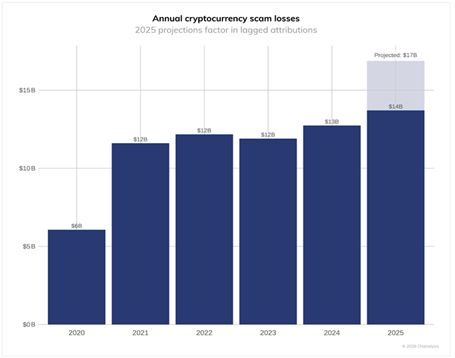
As the ecosystem expands, the barriers to entry are no longer technical but psychological. Security remains the primary concern for the mass market. Chainalysis data shows that losses from crypto fraud accounted for $17 billion in 2025. The data reveals a pivot in tactics. A 1,400% surge in impersonation scams suggests bad actors are bypassing code vulnerabilities to target human error directly.
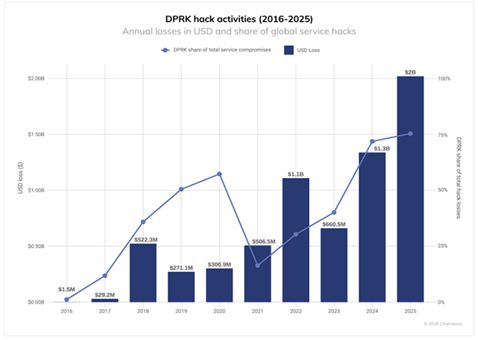
North Korean-linked groups also continue to operate at scale, stealing $2.02 billion last year and reaching a lifetime total of $6.75 billion. With threats coming from both social engineering and state-level hacking, platforms have no choice but to act as the first layer of security.
Risk controls at Binance prevented $6.69 billion in potential fraud losses and protected 5.4 million users from theft in 2025. This level of intervention is becoming a baseline expectation for mass adoption. Binance Co-CEO Richard Teng notes that institutional validation and user growth are deeply connected.
“The ADGM license crowns years of work to meet some of the world’s most demanding regulatory standards,” Teng said. “Arriving within days of the moment we crossed 300 million registered users shows that scale and trust need not be in tension: the more people trust the system, the more it grows – and the more growth rewards serious oversight.”
Fraud volume is now the primary obstacle keeping risk-averse users on the sidelines. Complex hacks grab headlines, but the data shows that everyday participants are the ones facing a rising tide of AI-enabled scams. This means mass adoption will likely stall unless platforms can become more effective in protecting users from these risks.
Education as a Growth Catalyst
Protection extends beyond preventing theft. It involves understanding what is being signed. OECD research highlights that consumer risk in digital finance is often exacerbated by a lack of understanding regarding complex products. Financial literacy has consequently morphed from a nice-to-have educational add-on into a critical security feature.
Understanding the basics of verification and custody turns users into harder targets. Education is the foundational piece that will drive mass user adoption while keeping those users safe from attacks. Binance CMO Rachel Conlan discussed the company’s investment into education at the WEF in Davos recently, “Financial literacy initiatives empower users to make informed decisions, reducing barriers to entry and fostering responsible participation.” Conlan continued, “Education is at the heart of Binance’s mission to democratize access to crypto globally. We invest heavily in accessible, multilingual educational content and programs. If crypto is going to reach the next billion users, education must evolve alongside the product. “
Platforms Building Safety Into Onboarding
Market structure is adapting to this safety-first mindset. Capital flows from new entrants show a clear preference for stability. CoinGecko’s figures show that the stablecoin market jumped 48.9% in 2025 to hit a record $311 billion cap.
Data from TRM Labs adds weight to this trend—showing that stablecoins now make up 30% of all on-chain transaction volume. This indicates users are utilizing blockchain rails for payments and settlement rather than purely for speculation.

Liquidity flows reinforce this flight to quality. Analysis from Wintermute shows that capital is no longer cascading broadly into small-cap altcoins as it did in previous cycles. Instead, liquidity is concentrating in Bitcoin and Ethereum, driven largely by ETFs and digital asset treasuries.
Platforms are responding by seeking gold-standard regulation to comfort these risk-averse users, exemplified by Binance’s recent authorization from the Abu Dhabi Global Market (ADGM). The era of moving fast and breaking things is over. We are entering a phase defined by steady movement and asset security.
Why Safety-Driven Growth Scales More Sustainably
Speculative trends are dying out faster. And this is a clear sign of a maturing market. Wintermute data reveals that the median altcoin rally lasted just 19 days in 2025 falling sharply from 61 days the year before.
This points to speculative fatigue. Users are burning out on fleeting narratives and seeking sustainable ways to participate. Memecoins and other small-cap tokens faded and structured environments like Binance Alpha 2.0 brought in 17 million users and saw over $1 trillion in volume. The appetite for crypto remains provided the environment offers clarity rather than chaos.
The next billion users will not be day traders obsessed with charts. They will be savers, merchants, and investors requiring the same safety guarantees found in traditional banking. For the industry to scale further, trust is the only metric that truly counts.