
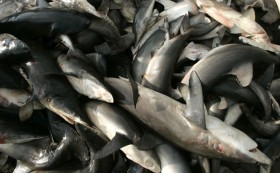
Six people were killed by sharks worldwide based on last year’s report. But when you come to think of that number multiplied by 12 million, you will find out how many sharks have been killed annually for human consumption.
Slaughtering sharks for an estimated number of 73 million each year came the result that only one third has left among all sharks species and it is now reaching its near extinction.
According to the director of the Pew Environment Groups Global Shark Conservation Campaign named Matt Rand, the sharks presently face a grave situation.
If this issue would not be immediately responded, the marine life will be feared of losing the shark’s big role in the ocean ecosystem for almost 400 million. To be able to prevent the rampant over fishing of sharks, everyone must at least be aware at hand.
A summit under the U.N. Food and Agriculture Organization will be held on Monday in Rome to tackle the adversities behind the global fish stocks. Where, nearly 70% of fishing areas are discovered to be totally exploited causing some to be fished out.
While Finning practices exist under shark fishing activities, the Pew environment Group and TRAFFIC have suggested that regulations on shark catching must be pushed on top of the agenda as a solution of focusing their plans about the shark extinction issue.
In Asia, specifically in China, shark fins are used as ingredients for cooking soup and making various products as well.
Removing fins of sharks and dumping its body shows how Finning is done. But such activity is outlawed by the US and EU causing its reinforcement to still stays unresolved.
With this concern, a 10-year action plan for sharks is intentionally implemented but still, only few countries have reached the marked of an excellent progress, according to the UN’s Food and Agriculture Organization (FAO) in 2005.
Indonesia, India, Spain and Taiwan are among the list of the top four shark catchers but in this regard, the only country that gives a breakdown on the kind of species it catches is the Spai
Encouraging the FAO to focus more on the shark dynamics, Rand hopes that they will recommit themselves to seriously take into consideration of the summit’s worldwide plan.
With this, the summit will be a good way to make them do an implementation as shark catchers make a difference.
On the brighter side, countries like Palau, Honduras, and the Maldives officially declared that catching sharks in their water territories are not allowed.
Valuing sharks tourism across the world gradually increases in coastal communities.
Based on Scott Henderson’s 20 years of living in the Galapagos, seeing sharks has been the main attraction in the place as he witness diving tours flocked in the said area.
Unfortunately, illegal shark fishing still exists in Galapagos even knowing that such place is considered to be a marine ecosystem that is mostly protected, according to Henderson.
With respect to the cultural traditions, fishing may not be inherently bad. Those who must actually be responsible to control behaviors are those markets and suppliers who must avoid rampant extinctions of sharks as well as other extinct creatures.
Catching sharks uncontrollably is considered to become a bid experiment in the ocean world as Rand describes.
Since that region from all over the world presently feels the decreasing number of sharks, a question formulates as to how far are sharks catchers will decline.
Henderson speaks that people must greatly be sensitive as to commit their views to help stop the m(–foul word(s) removed–)ive overfishing of sharks in any way.