
Here’s How Business Leaders Are Responding to AI Human-in-The-Loop

“Artificial intelligence can accelerate work, but people are still responsible for getting it right.” As SuperStaff expands its human-in-the-loop (HITL) model across its global operations, the company’s 2026 growth strategy is anchored on this premise.
The logic is straightforward: AI is well-suited to high-volume, rules-based work. It can process information quickly, standardize routine tasks, and increase throughput. But speed is not the same as sound judgment. Exceptions still need to be interpreted. Risks need to be weighed.
For outsourcing providers, this marks a significant change in the value proposition. The industry has long been associated with labor arbitrage and additional capacity. Increasingly, clients are looking for something more: access to people who can work effectively with technology, manage complexity, and improve the quality of execution.
The strongest models are no longer designed simply to supply headcount. They combine specialized talent, operating discipline, and technology-enabled workflows to give companies greater flexibility without lowering the standard of delivery. SuperStaff’s HITL model reflects that direction. AI improves speed and consistency. People provide context, oversight, and accountability. The advantage comes from how the two are designed to work together.
Empty Seats Come at a Higher Cost Than Most Companies Realize
Recruitment expenses are only one part of the cost of an unfilled role. When critical positions remain vacant, existing employees take on heavier workloads, managers spend more time covering day-to-day operations, and projects, customer service, and productivity can all suffer.
According to research, 74% of employers worldwide struggle to find the skilled talent they need.
This makes prolonged vacancies one of the biggest operational challenges businesses face today. As critical roles remain unfilled, organizations often rely on existing employees to absorb additional responsibilities, placing greater pressure on teams. To help address
these workforce challenges, many organizations are adopting Human-in-the-Loop (HITL) models that combine technology with human expertise. Nearly half of business leaders expect generative AI to be integrated into their core business processes within the next three years, increasing the need for skilled professionals who can oversee critical workflows and maintain quality as automation expands.
Missed deadlines, slower decision-making, declining employee morale, and inconsistent customer experiences can all stem from the same issue: not having enough qualified people in the right roles. This is why many business leaders are shifting their focus. Instead of asking how to reduce hiring costs, they’re asking how to fill critical roles before operational strain begins affecting growth.
Why Cost Is No Longer the Main Conversation
For years, hiring internationally was viewed as a way to reduce labor costs. While cost savings still matter, they are no longer the primary reason many organizations are expanding their talent search.
Today’s leaders are placing greater value on business continuity. They want to know whether they can find qualified professionals quickly, maintain service levels during periods of growth, and build teams that remain productive over the long term.
Instead of focusing solely on hourly rates or salaries, decision-makers are evaluating the overall value that new hires bring to the business. They are considering how quickly employees can become productive, how effectively teams can collaborate, and how hiring decisions contribute to long-term organizational goals. In other words, the conversation has shifted from finding the lowest cost to finding the right talent.
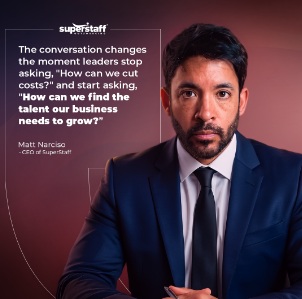
“The conversation changes the moment leaders stop asking, “How can we cut
costs?” and start asking, “How can we find the talent our business needs to
grow?”
— Matt Narciso, CEO of SuperStaff
Looking Beyond Local Talent Pools
Hiring has become competitive, with companies competing for the same pool of experienced professionals. In many industries, specialized skills are in high demand, making recruitment slower, more expensive, and more difficult.
To address these challenges, many organizations are expanding their search beyond local markets to access global talent. This broader talent pool helps reduce hiring delays, fill critical roles faster, and keep operations running smoothly without overloading existing teams. Expanding recruitment internationally also gives businesses greater flexibility.
They can scale teams more efficiently, respond to changing business demands, and maintain service levels during periods of growth. The goal is not to replace local employees but to strengthen hiring efforts by adding qualified talent when local recruitment alone cannot meet business needs.
The purpose isn’t to replace local recruitment but to complement it. By broadening the talent search beyond local markets, businesses gain access to specialized professionals, improve hiring flexibility, and reduce the time it takes to fill business-critical roles.
— Alessio Urbani, Business Development Director of SuperStaff
Access to Specialized Skills When They’re Needed Most
Some positions are especially difficult to fill, particularly in fields such as accounting, finance, customer support, technical support, software development, support engineering, and cybersecurity.
Many organizations are finding success by exploring other options, such as countries with well-established outsourcing industries, including the Philippines and Colombia. These markets have built strong talent pipelines supported by experienced professionals,
industry training, and a workforce that serves businesses across multiple sectors.
Access to specialized talent allows organizations to respond more quickly to changing business demands while maintaining operational stability. Rather than delaying projects or stretching existing teams too thin, companies can bring in qualified professionals who are ready to contribute and support business objectives.
Even as businesses adopt more automation across their operations, experienced professionals remain essential. Most organizations are not ready to let automation operate on its own. In fact, only about 15% are pursuing fully autonomous AI agents. Instead, many continue to rely on a Human-in-the-Loop (HITL) approach, in which skilled employees review outputs, make informed decisions, handle exceptions, and ensure that work meets business, regulatory, and customer expectations. This human oversight helps improve accuracy, reduce risk, and maintain the quality businesses and customers expect.
As digital operations continue to expand, cybersecurity has become an increasing priority. Organizations need qualified security professionals who can monitor threats, protect sensitive information, support compliance efforts, and strengthen business resilience. Access to cybersecurity talent has become just as important as hiring customer-facing or technical specialists.
Having access to skilled professionals when needed helps organizations continue to expand without sacrificing service quality, security, or operational efficiency.
Building a Workforce That Supports Long-Term Growth
Hiring is about finding the right people, not just filling vacancies.
The strongest workforce strategies focus on building teams that can grow with the business. That means hiring qualified professionals, improving retention, reducing turnover, and maintaining consistent service delivery.
Organizations are increasingly looking for hiring partners that provide more than recruitment support. They want partners that understand their business goals, identify the right talent, and help build stable, productive teams.
Many companies now prioritize partners that can:
- Deliver qualified candidates efficiently
- Shorten recruitment timelines
- Support employee retention
- Scale teams as business needs evolve
- Maintain consistent service quality
Stable teams strengthen collaboration, improve customer experiences, and allow leaders to focus on growth instead of constant recruitment.
The Future of Hiring Is About Access to Talent
The way organizations think about global hiring has changed. Business leaders are no longer expanding their talent search simply to lower costs. They’re doing it because local hiring alone can’t always provide the speed, flexibility, or specialized skills their businesses
require.
The organizations adapting most successfully are those willing to rethink traditional hiring strategies. Instead of limiting recruitment to one location, they are building workforce models that combine local expertise with access to global talent. This approach allows them to remain competitive while responding more effectively to evolving business needs. As talent shortages continue across industries, companies that broaden their hiring strategy are better equipped to maintain productivity, support their employees, and continue growing.
“The numbers tell the real story. Organizations that optimize their global talent acquisition strategy don’t just fill vacancies faster, they strengthen their ability to scale with confidence. By leveraging data-driven recruitment models, businesses can reduce time-to-hire, improve long-term retention, and maintain operational continuity. The result is a more resilient workforce, greater hiring efficiency, and lower Cost per Opportunity. Global hiring is no longer just about filling roles, it is a strategic investment in sustainable business growth.”
— Keiji Makita, Marketing Director of SuperStaff
Helping businesses put this strategy into practice, SuperStaff builds dedicated teams with the specialized talent and Human-in-the-Loop (HITL) expertise needed for long-term growth. This allows organizations to scale faster while maintaining the quality, flexibility, and operational resilience today’s business environment demands.
The SuperStaff Advantage
SuperStaff is a global BPO and outsourcing provider that helps businesses grow through flexible workforce solutions and reliable operational support. We connect organizations with skilled professionals across customer service, sales, back-office operations, technical support, finance, healthcare support, and other specialized functions.
Whether you need remote teams or dedicated on-site support, SuperStaff simplifies hiring with the talent you need to scale confidently. We build teams that align with your business goals and support long-term success.
Discover how SuperStaff can help your business grow at www.superstaff.com, or follow us on social media at @superstaffoutsourcing.